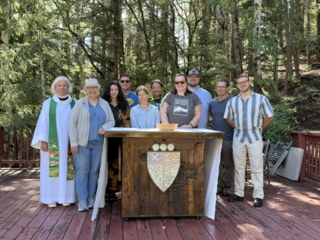
newly ordained priest and parishioner

Virtual Curacy

Transforming Leaders. Supporting Clergy in Their First Call to Ministry

Virtual Curacy

At Berkeley Divinity School at Yale, we are committed to forming compassionate servant-leaders for the Church and the world who are generous, wise, and equipped to bring healing to an aching world. 

The two-year Virtual Curacy program is designed to address the critical shortage of mentorship and traditional curacy opportunities for newly ordained Episcopal clergy. 

Generously supported by the Lilly Endowment Inc. and Trinity Church New York

Welcoming newly ordained priests from any seminary or local formation program, this innovative curriculum immerses new clergy in practical skills for ministry and adaptive leadership, ensuring they emerge as effective leaders capable of supporting vibrant Christian communities.   

Participants learn monthly in a cohort setting and receive weekly one-on-one support from a clergy mentor. The curriculum includes wisdom from Yale’s distinguished faculty and from ministry leaders across the Church. 

Curates who complete the program requirements receive a Certificate in Pastoral Leadership from Yale University. 

The Church needs newly ordained priests who are well prepared and well supported beyond their initial seminary education. Through the Virtual Curacy, Berkeley is delighted to partner with bishops and dioceses across the Episcopal Church to offer the mentoring, skill-building, and community necessary for the earliest years of ministry.

—

The Very Rev’d Dr. Gabrielle Thomas, Dean and President, Berkeley Divinity School at Yale

Who can become a Virtual Curate at Berkeley at Yale?

The Virtual Curacy is designed for newly-ordained priests serving in their first call. We know the path to ministry can be long and winding, so this is a guideline rather than a rule. Prospective curates must have diocesan approval to apply. We welcome people who are within two years of ordination to priesthood (before or after).  

How does the program work? 

The two-year program begins with an extended retreat in August followed by twenty monthly plenary sessions online that explore a variety of topics central to priestly ministry. 

Virtual Curacy Group after Outdoor Eucharist

The 2026-2028 cohort at their opening retreat in August 2026

Consistent weekly meetings with an assigned mentor also provide the needed support and apprenticeship so crucial to the curacy experience. Our mentors are seasoned priests who are specially trained for mentorship, bringing wisdom, experience, and dedicated guidance to every curate they accompany. After two years, the program concludes with a retreat and graduation at Yale in early June.

What topics are explored? 

The Virtual Curacy curriculum is grounded in four distinct areas of study. This program is not simply another academic course of study, but a way of life rooted in Christ-centered servant leadership. 

  1. Opening Retreat 
  2. Sacramental Practice and Leadership: Sacred time and Personal Prayer Life 
  3. Sacred Time: Managing the Dynamics of Vocational Balance 
  4. Mid-Course Quiet Day 
  5. The Parish Priest: Identity Formation
  6. Closing Retreat

  1. Sacramental Practice and Leadership: Preparation, Pastoral Care and Presence (Baptism, Eucharist, Funerals, Weddings) 
  2. Sacramental Practice and Leadership: Reconciliation 
  3. The Art of Preaching 
  4. Developing and Leading Stewardship  
  5. Creating a Music Program

  1. Creating a Sound Leadership Culture in the Vestry 
  2. Empowering & Collaborating with the Laity 
  3. Managing Money for Ministry 
  4. Governance as Sacred Work 
  5. Conflict Transformation 
  6. Communications Ministry

  1. Mentoring and Eldering 
  2. Adaptive Leadership: Leading Change with Grace 
  3. Adaptive Leadership: Congregational development 
  4. Fundraising Faithfully: Fundraising, endowments, capital campaigns 
  5. Pastoral Leadership and Politics 
  6. Building Future Readiness 

Download the 2026–2028 schedule (pdf) for a complete list of dates and times for 2025-2027 and 2026-2028 cohorts. 

Virtual Curacy Program Leadership

Tuition & Financial Aid

Tuition for the two-year program is $9,000 
Payment is due from your diocese July 1. 
Limited financial aid is available. Please reach out to Brandon Nappi for more information. 

Apply

On a rolling basis from November 1 through July 1 each year. Applicants can expect to receive a decision within one month of submission.

Application Portal

Testimonials

What a wild world it is out there as a brand new priest.  Don’t forget the basics: love those you serve, spend time with God, be patient, persevere, and ask for help. And wow, the Virtual Curacy program removes barriers by providing built-in mentorship, community, and library of content.  

-The Rev’d Anna Baumann, Diocese of Lexington 

Becoming a priest is a journey I’m still learning to walk, and the Virtual Curacy at Berkeley Divinity School at Yale has walked it with me. 

The faculty and staff went above and beyond advocating to open this door for me, welcoming me into a program built for newly ordained priests like myself. As a Puerto Rican woman stepping into this new calling, I’ve carried my heritage, my language, and my community with me every step of the way, and this program never asked me to leave any of that at the door. Instead, it gave me space to grow into ministry as fully myself: bilingual, rooted in my heritage, and shaped by a legacy of faith passed down through my people. 

In a time when so many of us are searching for belonging, it reminded me that I don’t have to choose between who I am and who God is calling me to be. 

This program has given me practical tools, pastoral wisdom, community, grounding, and courage. Resources that build on my seminary formation and will continue shaping me as I grow into a seasoned priest for all the people of God. 

Now, as I begin as Associate Rector, I carry all of it with me: mi fe, mi gente, y mi llamado.  

-The Rev. Mthr. Marycelis Otero, Diocese of Virginia 

The Virtual Curacy program has been a stabilizing and deeply supportive presence during my first year of ordained ministry. Serving as the only employee of a small parish, I have no one nearby to turn to with questions, but my cohort has given me a “small but mighty” community of peers who understand my experience, while bringing perspectives from across the country and a wide range of church traditions. My mentor has become a trusted friend and advisor who genuinely cares about my well-being and flourishing, and the program’s generous resources, knowledgeable leaders, and scholarship support have made this experience invaluable. 

I encourage every newly ordained person to take advantage of this program.  
-The Rev’d Melanie Yankey, Diocese of Lexington 

The Yale Virtual Curacy program offers an invaluable and much-needed opportunity for clergy in their first year of ordination and first call to engage in meaningful learning, mentorship, and support as they grow into their vocation as parish priests. 

I am deeply grateful to the program’s trainers, leaders, and mentors for the wisdom, care, and enrichment they so generously provide. Their support has strengthened my ministry and equipped me to serve my parish with greater confidence, clarity, and joy. 

-The Rev’d Danelie Millien, Diocese of New York 

As someone who took a non-traditional path to the priesthood, I felt like I missed out on the camaraderie of a seminary class of colleagues and professors who could serve as mentors for me in ministry. 

Through the Virtual Curacy Program, I now have both incredible colleagues all across the country, as well as wise and experienced mentors to help me grow and mature as a priest in the early years of my calling.  
-The Rev’d Taylor Johnson, Diocese of Alabama 

Frequently Asked Questions

Newly ordained and soon-to-be ordained priests from any Episcopal diocese are eligible to apply to the program with diocesan approval. If you are not sure whether you qualify, please email Dr. Brandon Nappi at brandon.nappi@yale.edu to discuss.

Yes, there is no limit to the number of priests who can participate from a single diocese.

No. Diocesan approval is required to apply to the program.

Tuition is $18,000 for the two-year program. This includes the opening and closing retreats. A sliding scale of tuition is available to dioceses based on their ability to pay tuition costs. Once a curate is accepted into the program, Berkeley Divinity will liaise with that curate’s diocese directly to sort out financial aid and tuition details.

Yes. While the program will prioritize newly ordained priests who do not have a traditional in-person curacy, traditional curates are most welcome to apply with diocesan approval. 

The cohort will be between 12-20 curates. 

The Virtual Curacy Program will be led by the Virtual Curacy Facilitator, an Episcopal priest with expertise in spirituality and leadership. The facilitator will different videos for each module, recorded for the Virtual Curacy, of distinguished Yale faculty and senior leaders in the Church and from non-profit and business leaders.

Admission is rolling. Admission decisions and financial aid awards will be communicated within one month of applying. Applications will close on July 1.

Each month, the curate will have 4 hours of mentoring and 2 hours of synchronous meeting time.

No. While we anticipate that most curates will hold an MDiv degree, the program also welcomes those who are locally trained and do not have a ministerial degree.

Virtual Curates will be responsible for writing Ember Day letters to their bishops each Ash Wednesday, reporting about their own progress in the Virtual Curacy. The curate’s facilitator and mentor will be standing by to help curates as needed with the writing of Ember Day letters. These Ember Day letters will provide an opportunity for curates to set off on the right foot, learning how to reflect on their own leadership journey and properly communicate with their bishop.

Yes, a Yale University certificate of completion will be offered at the end of the program. Full participation in the program is required to receive the certificate.